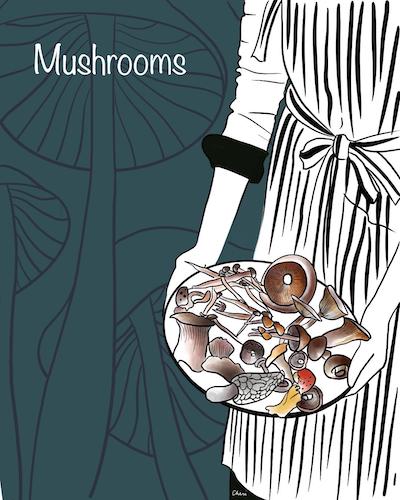
Imagine an ingredient that captures all your senses. One that is considered not only nutritious but deadly, alien yet immensely beautiful. Welcome to the enormous kingdom of Mushrooms otherwise known as fungi, that are connected to almost ninety percent of all vegetation on earth.
As enormous and tiny as they might appear, mushrooms are vital to all life on earth. They are part of our forest woodlands, gardens and even present in our supermarkets. Have you ever picked up blue cheese, a fizzy drink like champagne, soy sauce, bread, or detergents? Well, all of these and more have fungi present in them.
Deadly or Delicious?
Fungi evolved around one and a half billion years ago and to me, they are the most fascinating things on earth. I love to draw and paint them as much as I love to eat them. But as most of you might know picking or eating the wrong mushroom might just put you on the fast track to heaven. There are those varieties that are well known to most like the Button mushrooms, Shitake, Oyster, and the Ceps also known as Penny buns or Porcini mushrooms. Those are not so well known like the Ear, Coral, Yellow brain, or Beefsteak mushrooms. And those that are mildly or deadly poisonous like the Sickner, Poison pie, and the Death cap mushroom.
Breaking down this beauty.
Have you ever read Peter Rabbit?
Beatrix Potter who wrote Peter Rabbit was one of the leading mushroom biologists of her time and it is said that she was amazed by the beauty and scientific importance of mushrooms. I am as fascinated as she is though mine is more a visual and taste bud driven fascination .As deadly or delicious as mushrooms might be we could all agree that mushrooms are beautiful. So if you ever do forage for mushrooms in nearby forests, or buy them at your local supermarket let’s get to know them better.
The head of a mushroom is called a cap. The stalk underneath holds the cap and its ridges also know as its gills. Mushrooms have spores that are considered the seeds of these fungi. While above the ground, and during their lifetime mushrooms spew out millions of these spores a day giving birth to other mushrooms. Mycelium is the fungus’s root system. Mycelium has been found to extend for miles. As wide as 2,384 miles in the Blue Mountains. Imagine that, amazing isn’t it?
Taking and giving.
The main function of a mushroom is to give the plants and trees nitrogen, moisture, and other nutrients while enjoying its delicious sugars. However, in the case of the Honey fungus, it takes more than it gives breaking down and eventually destroying most vegetation with its digestive juices. This could be potentially dangerous for any forest as it destroys most vegetation in its path. Mushrooms generally feed on living organisms that are dead but others varieties feed n those that are alive. I never did believe this until I watched it recently on Nat Geo it was fascinating and scary at the same time.
So why do I find this ingredient truly magical?
Did you know that Mushrooms are the very reason the world’s organic matter has been silently recycled for years? They are crucial to the breakdown and decomposition of vegetation and the entire cycle of the soil web system. Not only that but a few years ago it was discovered that the mycelium of the beautiful oyster mushroom could be used to bond waste corn matter into blocks naturally and this is then reused to mold biodegradable packaging. Imagine that as an alternative to plastic!
What’s even more fascinating is Mycologists or the people that study mushrooms are now looking into breaking down chemical waste with the help of Mycelium. Antibiotics, cancer research, inflammatory diseases are all looking for and discovering solutions with this fascinating fungi also a close friend of the gnomes.

 Fr. Warner D'Souza is a Catholic priest of the Archdiocese of Bombay. He has served in the parishes of St Michael's (Mahim), St Paul's (Dadar East), Our Lady of Mount Carmel, (Bandra), a ten year stint as priest-in-charge at St Jude Church (Malad East) and at present is the Parish Priest at St Stephen's Church (Cumballa Hill). He is also the Director of the Archdiocesan Heritage Museum and is the co-ordinator of the Committee for the Promotion and Preservation of the Artistic and Historic Patrimony of the Church.

Thanks for the lovely recipe. However, may I please have your recipe for the pie crust?
Thank you n God bless.
Mariana Coelho