
THE BOMBAY SEMINARY: 10 Features of the Parel Seminary!

Did you know that the Parel Seminary was the third attempt at starting the Bombay Seminary? Did you know that Parel was the fourteenth location in its long and arduous travels? Read on to discover ten other interesting features of the Bombay Seminary at Parel:
-
The Student Body of the Seminary composed of three communities – the Latinist, the Philosophers and the Theologians. Each community had its seminarian Beadle (Prefect) and Father Minister. The communities had to observe the rule of ‘No Fusion’ pertaining to living quarters, refectory and games. Only on few occasions in the year the communities could mix and gather together.

-
Silence was observed in the whole House and was broken only during classes, recreation and games.
-
Students wore the cassock with a blue sash at all times – in the chapel, around the house, for class and when going out. The cassock was doffed only when the seminarians did manual work, played games and retired to bed. The new-comers received the cassock and blue sash on the Feast of St. John Marie Vianney.

-
Tonsure was conferred at the beginning of the study of Theology; the Minor Orders in the second and third years; the Sub-diaconate, the Diaconate and the Priesthood in the course of the fourth year.
-
The Sodality was introduced in the Seminary on February 2, 1954 by Fr. Casasayas S.J. who was Rector at that time. It was a voluntary association of seminarians who consecrated their entire life to Mary’s service. The sodalists grouped themselves into a number of sections and devoted themselves to visiting the sick and needy, special catechetical and pastoral work in the slums, rag-picking, etc. The sodality was suppressed in 1966.

-
During the Parel era, the seminarians tried their hand at publishing a Seminary Magazine entitled Fraternitas. This editorial endeavour lasted for around a decade.
-
The Parel seminarian studied sciences like Philosophy, Theology, Botany, Atomic Physics
-
Alongside the sciences, the Parel seminarian also learnt trades like ‘Barbering’, ‘Cobbling’, Typing and Cyclostyling along with some Fine Arts.

-
The staff of the Parel seminary also included a) Br Infirmarian who would take care of the medical needs, b) The Minister of Supplies who would travel to town to fetch fresh supplies for the seminary and c) The Minister of Home Affairs who looked after the cleanliness and the beauty of the House of God, the Chapel.

-
The last batch of seminarians ordained from the Parel Seminary included – Frs Peter Drego, Lawrence Monteiro, Alvaro Nazareth, Denis Pereira and Joseph Vincent. These were ordained in Bombay while Fr Eustace D’Lima was ordained in Rome and Fr. Joseph D’Souza in Mangalore.
Please feel free to share this story with others and your story of the Seminary with us! You will get regular updates at this blog site on this exhibition.
© – Archdiocesan Heritage Museum
Memorial of Our Lady of Sorrows

Memorial of Our Lady of Sorrows
“If anyone does not wish to have Mary Immaculate for his Mother, he will not have Christ for his Brother.” – St Maximilian Kolbe
The title, Our Lady of Sorrows, given to our Blessed Mother focuses on her intense suffering and grief during the passion and death of our Lord. Traditionally, this suffering was not limited to the passion and death event; rather, it comprised the seven dolors or seven sorrows of Mary, which were foretold by the Priest Simeon who proclaimed to Mary.
- The Prophecy of Simeon. Luke 2:34-35
- The escape and Flight into Egypt. Matthew 2:13
- The Loss of the Child Jesus in the Temple of Jerusalem. Luke 2:43-45
- The Meeting of Mary and Jesus on the Via Dolorosa.
- The Crucifixion of Jesus on Mount Calvary. John 19:25
- The Piercing of the Side of Jesus with a spear, and His Descent from the Cross. Matthew 27:57-59
- The Burial of Jesus by Joseph of Arimathea. John 19:40-42
History of the Memorial of Our Lady of Sorrows
The Devotion to Our Lady of Sorrows grew in popularity in the 12th century in the Middle Ages, also thanks to the constitution in 1233 of the Order of the Servants of Mary. By the fourteenth and fifteenth centuries, the feast and devotion were widespread throughout the Church. In 1667 the Servites obtained official approval for the celebration of the “Seven Sorrows of Mary”, a number based on as many episodes narrated in the Gospels
Interestingly, in 1482, the feast was officially placed in the Roman Missal under the title of Our Lady of Compassion, highlighting the great love our Blessed Mother displayed in suffering with her Son. The word compassion derives from the Latin roots cum and patior which means to suffer with.
MARY A MASTERPIECE – ‘Madonna of Humility’ by Fra Angelico, National Art Museum of Catalonia, Barcelona; 1433 – 1435

If the land that Jesus walked on is Holy, imagine the tomb that bore Him
The Madonna of Humility is a painting by the famous Fra Angelico. Born Guido di Pietro, the honorary epithet of ‘Fra Angelico’ or ‘the Angelic Brother’ was attributed to the painter after his death in 1455. His love for Christ led him to join the religious order of the Dominicans between 1418 and 1421.
Vasari, the great author of the ‘Lives of Artists’ (1550), describes Angelico as a ‘simple and most holy man who painted with facility and piety’. The art historian adds, ‘Fra Angelico never set his hand to a brush without first saying a prayer. He never painted a crucifix without tears streaming down his cheeks. He befriended the poor and now is befriended by Heaven’. Holding to Vasari’s words, in 1982, St. Pope John Paul II proclaimed the beatification of this ‘Blessed’ painter. He recognized him as the ‘Saint of all Artists’.
The beauty and essence of the painter’s life are reflected in today’s canvas. Titled ‘The Madonna of Humility’, the composition belongs to the Thyssen-Bornemisza Museum in Madrid. It is currently conserved on loan at the National Art Museum of Catalonia, Barcelona.
Unlike popular medieval representations, the Blessed Virgin is not seated on a majestic Gothic throne. Rather the Virgin of humility rests against a cushion directly placed on the ground. She is cloaked in blue (divinity), red (humanity), green (life), and gold (glory). Executed with meticulous foreshortening, her flowing drapery lends movement to the still image. A little star twinkles upon her right shoulder. Could it serve to remind us of the guiding star of Bethlehem? Further does it not hail Mary as our guiding star, who continues to lead us to her Son Jesus?
THE BOMBAY SEMINARY: A Virtual Picnic with the Parel Seminarians!

Today the idea of basking in the sunshine at a mountain top or an open beach surrounded by a loved-ones seems but a distant dream. However, with technology at our disposal, we can journey through time and space.
A quick background before we embark upon this virtual picnic. It is important to note that the daily life of a Parel seminarian was filled with activities that fostered holistic formation. However, not only does physical and mental health require periods of relaxation, but also personal and spiritual formation demands that an important role is given to games, hobbies, outings, and the like.
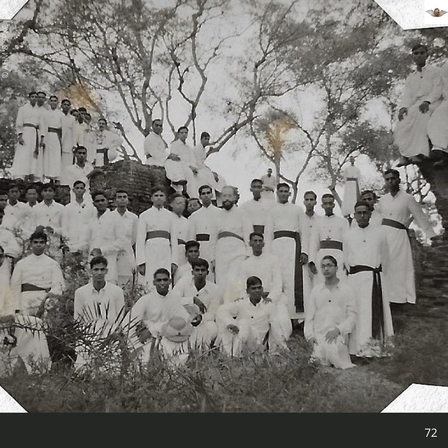
At the Parel Seminary, group picnics were scheduled regularly in the year. The House-Picnic of the year, whose site was carefully selected and whose arrangements were enthusiastically undertaken, was that in honor of the Rector.
As recorded in the seminary magazine, the Diwali holidays (October – November) were spent in the hills of the verdant Khandala with great eagerness. The activities included daily swims, strenuous hikes, campfires, etc. culminating with the Seminary Sports on the grounds of St. Mary’s Villa.
Though the times and places have changed, through the following picture-trail we offer you a glimpse of the past picnics.


Hello!
 Fr. Warner D'Souza is a Catholic priest of the Archdiocese of Bombay. He has served in the parishes of St Michael's (Mahim), St Paul's (Dadar East), Our Lady of Mount Carmel, (Bandra), a ten year stint as priest-in-charge at St Jude Church (Malad East) and at present is the Parish Priest at St Stephen's Church (Cumballa Hill). He is also the Director of the Archdiocesan Heritage Museum and is the co-ordinator of the Committee for the Promotion and Preservation of the Artistic and Historic Patrimony of the Church.
-
Anthony Murray Thank you Padre for your clear and defined analysis on true martyrdom and how it
-
PiusThoughts 202607-18-FrWarner – Sat 18-Jul-26 (When life deals you pain..) – St. Pius X Church […] Fr Warner D’SouzaSource: PottyPadre.com […]
-
Acts of the Apostles
ActsOfTheApostles
Advent
Advent2022
ArchdiocesanHeritageMuseum
Archdiocesan Heritage Museum
Archdiocese of Bombay
ArchdioceseOfBombay
ArtAttack
BombaySeminary
catholic
cheriillustrates
Easter
Easter2023
Faith
Friday
Goanfood
GospelofLuke
Gospel of Mark
indianfood
Jesus
John's gospel
Johnthebaptist
Lent
Lent2021
Lent2023
Lent2024
Lockdowncooking
Mary
Matthew's Gospel
Monday
padrecancook
padreinthekitchen
Padrewarner
Pharisees
pottypadre
Prayer
sacredart
SacredArtInHundredWords
Saturday
Scripture
StPiusXCollege
Thursday
Tuesday
Wednesday