
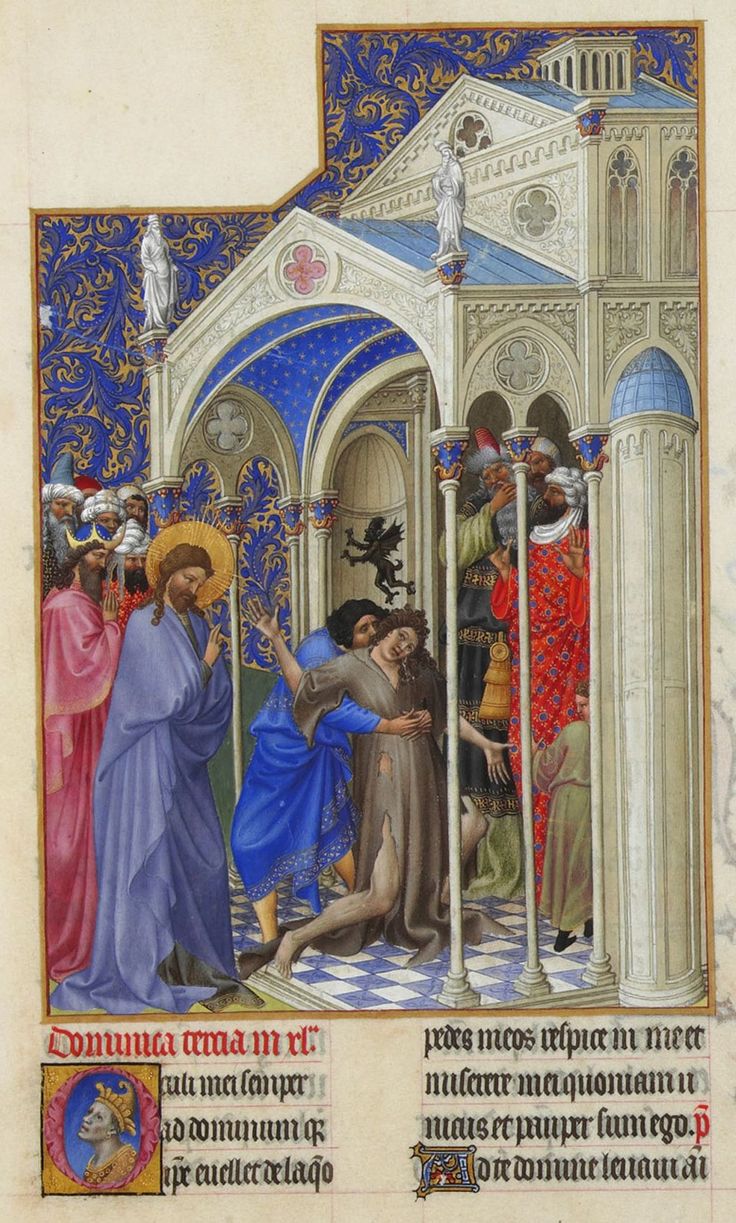
AUTHORITY, ART and AMAZEMENT: Jesus drives out a demon or unclean spirit, from the 15th-century Très Riches Heures

AUTHORITY, ART and AMAZEMENT: Jesus drives out a demon or unclean spirit, from the 15th-century Très Riches Heures (Very Rich Hours)
INTRODUCTION TO ILLUMINATED MANUSCRIPTS:
As we unfurl the pages of history and zoom past a century we encounter an age of type written and hand written documents called Manuscripts. Hidden among its fragrant fascinating pages are the greatest and the finest arts of the Middle Ages. This includes text supplemented with a variety of decorations such as initials, borders and illustrations. Embellished with ornate gold and silver, the scripts are referred to as Illuminated manuscripts.
THE BOOK OF THE HOURS:
The greatest illuminated manuscripts were often liturgical in nature. The most popular of these is the Book of the Hours. It is an abbreviated form of the Breviary which includes the Divine Office as recited in the monasteries. The breviary was further developed into the Book of the Hours in order to adhere to the desires of the laity who wanted to incorporate the virtues of monasticism in their daily life.
Written in Latin, the Book contains a Calendar of the Church feasts, weekly cycles of psalms, prayers, hymns and readings. Grooms often presented these as a wedding gift to their brides. Regarded as a family legacy, it was then passed down through generations and mentioned in wills.
TRES RICHES HEURES (VERY RICH HOURS)
The greatest, famous and finest example of an illustrated Book of the Hours is the Tres Riches Heures du Duc de Berry. It was conceived between 1412 and 1416 for the extravagant royal library of its patron John, Duke of Berry by the Limbourg brothers (Herman, Paul and Jean). Although faint in the fog of history, the Limbourg brothers were the best miniature painters in 15th century France.
Human beings and not doings

When small is beautiful- Friday, 3rd week in ordinary time- Mark 4: 26-34

When small is beautiful- Friday, 3rd week in ordinary time- Mark 4: 26-34
The ‘Kingdom of God’ is back into focus with two parables, both using the example of seeds. Interestingly, the sacred writers never limit the description or definition of the Kingdom of God. For them it is always ‘like’ leaving room for the ever growing possibilities that God can bring His kingdom to.
Any farmer in Jesus’ audience listening to Him would have been left puzzled both at the deceptive simplicity of the first parable, and with a bit of shock at the second (4:30-32). The Kingdom of God and mustard seeds simply don’t belong in the same sentence! The mustard bush is a garden pest and no one would sow it on purpose. It grows all too readily on its own, and once it appears, it takes over the field. The small size of the mustard seed may be proverbial (Matt. 17:20; Luke 17:6), but it is not the smallest seed, nor is the mustard bush the largest of all shrubs. So there must be an explanation for the exaggeration.
Let us begin with the point of the parables. The arrangements of the parables are all related to the Kingdom. The Early Church that read Mark’s Gospel lived in the shadow of political and religious persecution. There may have been some in Mark’s community who wanted to hurry the coming of the Kingdom by taking up arms against the Romans.
Also, Christianity was yet an infantile faith in the face of well-established religious creeds whose structures vied for superiority in the Roman world. The possibility of an inferiority feeling may have well crept into the hearts of the early Christians; would their faith ever propagate as had the other religions?
So, even though the superlatives are inaccurate, the contrast between a small seed and a large plant fits well as an image for the reign of God. It would have been good news to people aware of the small beginnings of Jesus’ ministry or of their own struggling community. The almost predatory ability of the mustard plant could crowd out the planned crops of the Romans and bring about God’s Kingdom.
The rest as they say is HIStory- Conversion of St Paul

The rest as they say is HIStory- Conversion of St Paul
Saul became Paul and shaped our life. Our attempt here is to see what shaped his life. Hence we are looking at the historical Saul who was converted from Judaism to become Christ’s most ardent follower. He was an Ambassador for Christ whose mission was to the Gentiles.
Born Saul, he grew up in the city of Tarsus, South west of Turkey. Tarsus was a fertile land and traded in textiles. Governed by the Romans, perhaps even before Paul’s birth, the city had a port and this brought prosperity to Tarsus.
The fact that Paul grew up in a city and that he was well versed in Greek and philosophy, helped him win an edge over the simpler disciples in Jerusalem. Later, his travels will see him in various cities in the Roman Empire, where he will be comfortably engaging a multi-cultural society.
Paul was a Roman citizen. The question often asked was how did he come by his Roman citizenship? According to Fr O’Conner, a scripture scholar, Paul was the son of a Roman slave; by profession he was a tentmaker, indicating that perhaps his parents were craftsmen. In all probability, his parents were set free. There is enough evidence in the Roman world to show that slaves were not considered an asset beyond the age of 40 and hence their masters set them free. The law stated that the children of slaves of a Roman citizen were automatically granted Roman citizenship when their parents were set free.
Paul spent his life under Roman rule. The Jews like Paul, believed that that they were the chosen ones. The presence of these pagan rulers only pushed the Jews into apocalyptic mode. Many of the Jews believed that the end was near. There were two reactions to the Roman occupation. The first was armed resistance and the second was the belief that the end of days could be hastened by holding strictly, the Jewish law. Paul was a believer in the latter. He was a Pharisee.
Hello!
 Fr. Warner D'Souza is a Catholic priest of the Archdiocese of Bombay. He has served in the parishes of St Michael's (Mahim), St Paul's (Dadar East), Our Lady of Mount Carmel, (Bandra), a ten year stint as priest-in-charge at St Jude Church (Malad East) and at present is the Parish Priest at St Stephen's Church (Cumballa Hill). He is also the Director of the Archdiocesan Heritage Museum and is the co-ordinator of the Committee for the Promotion and Preservation of the Artistic and Historic Patrimony of the Church.
-
Anthony Murray Thank you Padre for your clear and defined analysis on true martyrdom and how it
-
PiusThoughts 202607-18-FrWarner – Sat 18-Jul-26 (When life deals you pain..) – St. Pius X Church […] Fr Warner D’SouzaSource: PottyPadre.com […]
-
Acts of the Apostles
ActsOfTheApostles
Advent
Advent2022
ArchdiocesanHeritageMuseum
Archdiocesan Heritage Museum
Archdiocese of Bombay
ArchdioceseOfBombay
ArtAttack
BombaySeminary
catholic
cheriillustrates
Easter
Easter2023
Faith
Friday
Goanfood
GospelofLuke
Gospel of Mark
indianfood
Jesus
John's gospel
Johnthebaptist
Lent
Lent2021
Lent2023
Lent2024
Lockdowncooking
Mary
Matthew's Gospel
Monday
padrecancook
padreinthekitchen
Padrewarner
Pharisees
pottypadre
Prayer
sacredart
SacredArtInHundredWords
Saturday
Scripture
StPiusXCollege
Thursday
Tuesday
Wednesday