
What happened to our compassionate saviour? Wednesday, 18th Week in ordinary time – Matthew 15: 21-28
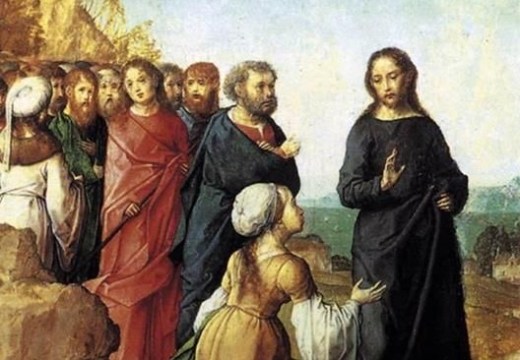 What happened to our compassionate saviour? – Wednesday, 18th Week in ordinary time – Matthew 15: 21-28
“Are you still without understanding” (Mt 15:16) was surely a statement of frustration from Our Lord. Not only had he to deal with the scribes and the Pharisees who had travelled from Jerusalem to reprimand this new Rabbi on the block (15:1) but he also had to deal with his own who did not understand what he stood for. They, as we know in Matthew 15:12, would rather please the Pharisees than follow Christ. “Blind guides of the blind,” was Jesus’ retort to these self-styled religious guardians of faith.
Perhaps it was this that pushed Jesus to take a trip further North West into what was for the Jews, forbidden land. Tyre and Sidon were ancient Canaanite cities which were renamed Phoenicia (‘Phoenicia’ was the name given to the region by the Greeks, from their word for purple). The names of Tyre and Sidon are mentioned several times in the Old Testament.
Situated in modern-day Lebanon, these were the traditional enemies of the Israelites. The people of this land, which Israel conquered under Joshua, were considered pagans by the Jews. Many of the Canaanites had been pushed northward into Phoenicia when the Hebrews invaded the territory. The hatred was mutual and understandable.
This narrative is very relatable when you look at it from the perspective of socio-cultural alienation or simply racial discrimination. Just before Jesus departed from the Sea of Galilee, He addressed the issue of defilement. His disciples asked Him about His comments. He answered them, “It is what comes out of a man, that defiles him.”
I would like to think that this was a test for the disciples to see if they were prejudiced. Unfortunately, the disciples failed this test as well. We are told that a woman (Matthew identifies her as a Canaanite and Mark says a Greek, a Syro-Phornicain by birth) came to Jesus and cried out to Him, “Have mercy on me, O Lord (Kurios), Son of David! She cried for mercy because as a Canaanite, she was not part of the covenant community, yet she knew that Jesus was the God and King of the nation of Israel. She now states her need for her daughter is severely demon-possessed.” She heard from others that Jesus was in town and knew that He had cast out demons in Galilee. She may have thought, “This is the Man that could take care of my daughter’s problem.”
The next line is perhaps the hardest line to read; a line that does not sit well with the loving Saviour we know Jesus to be, for we are told, “he did not answer her at all.” It is at this moment that the disciples chime in. They misinterpret His silence as a rejection of her. Their nationalistic pride led to prejudice against this woman, so they discriminated against her by saying to Jesus, “Get rid of her! She is harassing us as well.”
When we read the text, it seems to us that Jesus at first ignores her, while addressing His disciples. He seems to give them and not her, His rationale for not helping; “He was sent only to the lost sheep of the house of Israel”. Here is where Jesus meets His Waterloo. Never underestimate the power of a desperate mother and if it means that she has to kneel before Him and beg, then kneel she does.
It’s a bit mind-boggling to think that this compassionate Saviour has turned her down twice already and the second time He does it with what seems like an unexplainable slur; “it is not fair to take the children’s food and throw it to the dogs”. Not only is this harsh to hear but even more repugnant when you realise that this was a contemptuous way of referring to the Gentiles; they were called kuon, meaning “wild cur” or an unclean dog. Jesus however uses the word kunarion, meaning “small dog” or “pet dog”. He did not insult her as the Jews did with the Gentiles, by calling them dogs but was merely explaining a point, using an example of a pet dog.
Perhaps it is a mother’s instinct that kicks in, one who will not be deterred by apparent negativity or insult. She is willing, even if it has to be like a pet dog, to joyfully accept the scraps. Heads must have turned listening to that comment and perhaps in Matthew’s community, hearts must have changed. It certainly made a deep impression on Jesus for repeatedly until now, He has had to chastise His disciples and even Peter for their little faith. It was a Gentile, an outsider, a foreigner, one considered unclean and slurred upon, who wins the heart of Jesus with her ‘great faith’.
Surely but steadily, Matthew’s late first-century readers were getting the point. The claim to merely be Abraham’s children would get them nowhere if they did not mirror the ‘great faith’ of their historic enemies.
The day belonged to the underdog!
The corruption of the faith – Tuesday, 18th Week in ordinary time – Memorial of St Dominic – Matthew 15:1-2, 10-14

The corruption of the faith – Tuesday, 18th Week in ordinary time – Memorial of St Dominic – Matthew 15:1-2, 10-14
This is a hard text to teach and one that could be easily misrepresented if one misses the woods for the trees.
To begin with, this is a watershed moment. We are told in 15:1 that the Pharisees and scribes have come from Jerusalem with a singular purpose; to question Jesus. Clearly, this itinerant rabbi was making waves in Galilee and reports of his teachings have reached the religious headquarters in Jerusalem. We are not told if this is some official delegation sent to question Our Lord but what we do know, is that their question itself was an accusatory one. If that be said, then their intention was not to understand but to attack.
One would have thought that the Pharisees and scribes have journeyed this long and arduous distance because of some doctrinal issue that has come under their scanner. Yet their question to Jesus is not doctrinal but more a ‘violation’ of a social customs that had found religious approval over the years. The Pharisees ask Jesus, “why do your disciples break the traditions of the elders? For they do not wash their hands before they eat.”
The danger to any religion is when one forgets the core tenants and commandments and gets distracted with peripheral and inconsequential social customs that some how manage to attach itself to religious sacraments, celebrations and customs. The local practice of Catholicism, like the local practices of most religions, are filled with such ‘home-spun’ traditions.
Let us look at the ‘traditions of the elders’ that have brought the Pharisees and scribes all the way from Jerusalem to Galilee. “Why do your disciples not wash their hands before eating?” In order to understand why this question is so important to this religious delegation one needs to understand that the Jews came to believe that ‘Shibtah’, a demon, attached himself to their hands as they slept and hence ingesting food would be ingesting the demon.
For the Jew, the Christian or any person of any religious faith, what should matter, is the core teachings in its written form. For the Jews, the Torah (or the Pentateuch as Christians call it) which consisted of the first five books of the Bible, constituted the written law. This is the core of the Jewish faith. Besides this, a section of the Jews, namely the Pharisees, began to accept the oral law that they claimed came from the time of Sinai. Remember that the written law, namely the Torah, is not in question here and Jesus has not spoken a word against the Torah.
These oral laws were then codified into the Mishna and Talmud which were commentaries on the commentaries of the Law. The Mishna is a commentary on the Torah and the Talmud is a commentary on the Mishna. The Talmud itself consisted of 8 volumes consisting of a total of 63 books. Remember that these book do not tackle the written law but the oral law and that’s a lot of oral tradition to follow.
So much of faith has been corrupted by traditions that are attached to religion. So many social demands are made of people in the name of religion at the time of Baptisms, Marriages, First Communion and Funerals. The sacraments of penance and the anointing of the sick, which truly deserve a social celebration, are relegated to muted responses. The point I wish to make is crystal clear; what is essential to the faith and core to the tenants of Christianity are rarely practiced with the fervour and devotion by people of faith but the peripheral human traditions have taken centre stage.
Christ deplores this behaviour and in no uncertain words takes on the Pharisees and the scribes. They came to question him with frivolities, while they themselves broke the core commandments of God. “Why do you break the commandments of God for the sake of your traditions.” There! Jesus has really got himself in big trouble! The irony is that we can get away as preachers with doctrinally incorrect statements (for none is the wiser) but dare we challenge the flowers and the candles on a grave or the cake and the confetti at a wedding or the boxes distributed at month’s mind masses and all hell breaks loose.
Are you offended reading what I just wrote? I wont be surprised if you are because no sooner had Jesus tackled the Pharisees and scribes (read verse 4 -9) than the ‘concerned’ disciples of Jesus come running to him. “Do you know that the parish council (sorry Pharisees) took offence when they heard what you said?” Oh! I did it again! Have I stepped into a quagmire of beloved religious traditions and offended my readers and listeners?
Let me tell you Christ’s reactions to this home spun religious ‘controversy;’ he took it on by its horns, threw the political correctness into the garbage where it belonged and proclaimed that “it is not what goes into the mouth that defiles a person, but what comes out of the mouth that defiles (him/her) (15:11)
Did Christ even care for the Pharisees and the scribes who had come down officiously from their headquarters in Jerusalem? His response was so brutally honest, “LET THEM ALONE” (verse 14). They were undeserving of his attention and of ours.
I warned you at the start of this teaching that this is a hard text to teach especially when scripture holds a mirror up to us. Christ calls the Pharisees in verse fourteen “blind guides of the blind.” That is an interesting statement because he is calling out the ignorance of these religious leaders and the stupidity of their blind followers. In the final reckoning they will be “uprooted” for they have not been planted by God but have planted themselves as religious leaders (read verse 13).
So much of our beautiful Christian faith has been distorted by religious traditions. I am not calling for a boycott of a wedding reception that follows the sacrament of matrimony or any other sacrament. Celebrations are important and serve a social need but when traditions after traditions are layered one over the other and these traditions take centre stage over the essential doctrines of the faith. When we look the other way, when a relative who never takes their child for Sunday mass insists on all the frills and fancies for their child’s fist communion, or when Christian couples who have rejected the faith want to get ‘married in Church, white dress et al or when all this and much more happens in God’s name and the rest of us hold our breath because this is ‘not our business’, then we are nothing but ‘the blind leading the blind and are culpable of the corruption of the faith.
We have nothing – Monday,18th week in ordinary time – Matthew 14:13-21

We have nothing – Monday,18th week in ordinary time – Matthew 14:13-21
This by far has been one of my favourite narratives in the Bible. It was the first homily I ever preached. I was a seminarian when I was asked to share my thoughts on this passage at St Theresa’s Church in Bandra. I was all of 22 years then. But for me, this is not merely a sentimental passage from scripture but one that teaches me never to tell the Lord, “we have nothing.” (Verse 17)
Our fascination for the spectacular miracle of the loaves and the fish overshadows the reality in which this miracle narrative is set in. Our Lord has just been told that his cousin, the first prophet in four hundred years had been brutally beheaded. His murderer (notice i call him that) King Herod, was concerned for his good name before men; in doing that he lost his soul before God. Our foolish desire to please men, while on earth we live, will be the reason why we loose our place in heaven.
In his moment of grief, Our Lord desired to be alone but the more he sought solitude the more the crowds sought him. Clearly, these were people hungering for a loving shepherd and no matter where he went they followed. They did not ask for an air conditioned room and comfortable seating. They longed for the comfort of the words that came from his lips and the healing touch that brought them back to life.
The Gospel tells us that it was evening. The disciples seeing the administrative challenge of handling such a large crowd found the easiest solution; “send them away.” Notice how this continues to be the response of much of the Church today (Both laity and clergy). Washing our hands has become second nature to us. We justify our response by thinking that this is not our responsibility, not the scope and the nature of the work of the Church. It is easy to find comfort in a pew, praying fervently for the poor, than to put an apron around our waist and feed the poor.
Christ was driven by his compassion for his people.(verse14) He knows that darkness will soon fall and he is concerned not just for their spiritual well being but also their physical needs. The disciples on the other hand see the crowds as a problem and the usual reaction to a problem is to ignore it entirely or deal with it swiftly before it becomes a greater challenge. The response of Jesus is marked by compassion; he wants to get involved and wants us to be involved. “They need not go away, you give them something to eat.”
It is not that we do not have anything to give; we have sadly become a people that have learnt to primarily receive. Christ did not ask that we give a great thirteen course meal to the hungry. He simply asked us to give “something” and there is no one who does not have a little something to give. The disciples response betrays the selfishness of humanity; “we have nothing here but five loaves and two fish.”
Five loaves and two fish may seem insignificant compared to the five thousand that needed to be fed. Christ will take what ever we have, provided we are willing to offer what we have. I am not sure if the disciples were really offering the five loaves and the two fish or protesting that they would have to share it. But Christ took it anyway.
It would be short sighted on our part to settle on the miraculous multiplication of the loaves and the fish; even though it is a narrative with a great and positive ending. While this miracle should not be diminished to some naturalistic explanation, there by diminishing the power of Our Lord, it also calls us to respond to the ‘miracle’ that caring and kindness can bring about in our society.
My dear friend, guide and mentor, Bishop Agnelo Gracias, once shared with me, that ever so often, he goes through the things that he possesses. If it was just lying in his cupboard unused for more than three months then it was clear that he did not need it and at once he would give it away. I have used this principle ever so often in my life. The moment of giving is really hard but once it is gone you know that someone more deserving of it was blessed. Today, would be a good day to begin.
Bearing my soul on Vianney Day – Matthew 13:54-58

Bearing my soul on Vianney Day – Matthew 13:54-58
There are no coincidences; God always has a plan and he chooses the moment and method that he wants to speak to us. The text of today is his voice speaking to me on a day that I am called to reflect on the life of our patron, St John Vianney; the Parton of the diocesan clergy
In so many ways, this text touches my soul. Over the past several years, the Lord has been using me to teach his word. It began first with the written blogs. I used to write with trepidation, afraid that I might make a mistake in my teaching; afraid of criticism. Then, Covid forced what was written to also be ‘vlogged.’ Now I had a face to the text that was written and every word I said was recorded for posterity. One slip, one mistaken line and the repercussions would follow.
I soon came to realise that it was not my words that flowed in every scripture reflection I wrote, but HIS. There were times my fingers few over the keypad; they could not match the pace of the thoughts that HE poured into my head. Words, sentences, ideas and clever lines were given to me and given to one who could barely pass his seventh grade math and who had to alter his report card so as to not get a beating at home for failing yet again. (Well I did get the beating all the same and doubly so for being dishonest)
I am not a clever man; I just had to work harder than every one else. I grew up in the shadow of a very intelligent brother. To make matters worse I was a shy kid who got bullied so often. I am not the extrovert the world thinks I am, I just had to learn to stand up for myself before I was taught to stand up for Christ. I know how weak I am, how frail I am and how short I fall in my Lord’s eyes. Yet he chose me for reasons I cannot fathom. His words ring in my ears, “you did not choose me, I chose you and I appointed you to go and bear fruit.”
The Gospel text of today, on this the feast of my patron John Vianney, gives me consolation. The Lord chose a broken vessel to water his garden. A broken vessel may not carry all the water to its intended source but being ‘cracked’ it drips along the way giving life to the arid ground below which was never intended to be watered by man. But life springs where it was never intended to and that is the work of God who uses even a ‘cracked-pot’ like me to bring life to others.
But if Christ was rejected then why should I expect preferential treatment? Can a servant greater be than his master Christ the Lord? (John 13:15 -17) Christ was rejected by his very family and the members of his own hometown. They knew who Jesus was, so they asked “who does he think he is?” He was labelled, written off and sneered at, based on their limited knowledge of their reality of him. For them, he was the son of a carpenter, a boy from the village; they could not see God in their midst.
Rejection is part of priestly life. The irony is, that most of your congregation love you but never tell you this. If you are lucky they will tell you how much they will miss you, that on the day your transfer notice kicks in. Yet there are those who will hate you and make sure you know it. I have had my share of haters; not entirely because of my human limitations but more for the causes of truth that I feel compelled to represent.
As a seminarian, I don’t think my professors thought much of me. I was not one who seemed to walk with the trendy theology of the time. Justice was a hot topic in the seminary back in the 1990’s. An option to live in the slums was seen as ‘more worthy’ of seminary formation than one who chose to live in the hallowed walls for which formation was created. But God does not go with the trends of theology; his message and truth was meant to be eternal.
When the moment came for me to stand for the rights of the people in Bandra, the Lord gave me a disciples tongue. He replaced courage where fear ought to have been a normal response. Ironically, I was attacked by my own brother priests, whom I suspect, rather pleased the powerful than petition the cause of the poor. I bear no animosity against them and while I know that some may have “taken offence” others asked contemptuously, “where did this man get all this?”
“Prophets are not without honour except in their own country and in their own house.” Christ who experienced rejection reminds his clergy that while they will be loved by many they must also be rejected by those within their inner circle, for standing up for the truth of Christ.”
When presented by Napoleon with the Imperial Order of the Legion of Honour St John Vianney refused to accept it. He said “when I go before my Lord, will I show him these human trifles?” I must admit that as a young priest I thought a skull cap would fit well on my head. I hankered for honours and position. It took a friend who looked me in the eye and said, “you are becoming a career priest.” Thank you Dominique Cerejo for you honesty; thank you for saving my soul. I now know that the Lord did want a cap for me but it was not what I imagined. He wanted me to share in his crown of thorns for that fits well and though I have an inkling that this crown will soon be pierced deeper, I also know that he will stand by me in my trial.
My prayers today are for my brother priests who are in far flung mission stations, where bread is hard to get and fear of persecution looms large. We who are blessed to minister in cities, in the relative comfort, if not the luxury of our ivory towers, must step out and become the voice for our brother priests who labour in challenging situations or else we will look like beautiful ships resting in a harbour but then again, that is not what ships were made for. Christ calls us to speak for the voiceless, to care for the poor, defend the faith and oppose every false power that be; both within and without the Church and boy, do the ones within the Church abound!
This piece is not written with malice to any one though it may oddly seem so. It is not meant to set me on a pedestal over the rest. It is a reminder to ALL the members of the clergy that we share in his priesthood and if we are not rejected like Christ, then it has become painfully clear that we do not stand on his side but that of the world. Christianity by its very tenants stands against the ways of much of this world. The minute you oppose it, you will find yourself carrying a heavy cross as you are led away to be crucified.
Finally, I want to apologise to those who I have hurt deliberately and the many many more whom I have offended unknowingly. The brashness of my first years as a young priest hopefully have given way to a more mature approach to the people that God entrusts me with. For me, these two years of a sabbatical, is an opportunity to sit on the sidelines and to serve without post or position the Lord’s flock, where ever I may be.
-
Dedicated to the memory of Fr Stan Swamy, who thought not a Diocesan priest, was very much a priest after God’s own heart. May the Church recognise what many of the laity acknowledge; that we were privileged to live at a time when a saint lived in our midst.
Hello!
 Fr. Warner D'Souza is a Catholic priest of the Archdiocese of Bombay. He has served in the parishes of St Michael's (Mahim), St Paul's (Dadar East), Our Lady of Mount Carmel, (Bandra), a ten year stint as priest-in-charge at St Jude Church (Malad East) and at present is the Parish Priest at St Stephen's Church (Cumballa Hill). He is also the Director of the Archdiocesan Heritage Museum and is the co-ordinator of the Committee for the Promotion and Preservation of the Artistic and Historic Patrimony of the Church.
-
Anthony Murray Thank you Padre for your clear and defined analysis on true martyrdom and how it
-
PiusThoughts 202607-18-FrWarner – Sat 18-Jul-26 (When life deals you pain..) – St. Pius X Church […] Fr Warner D’SouzaSource: PottyPadre.com […]
-
Acts of the Apostles
ActsOfTheApostles
Advent
Advent2022
ArchdiocesanHeritageMuseum
Archdiocesan Heritage Museum
Archdiocese of Bombay
ArchdioceseOfBombay
ArtAttack
BombaySeminary
catholic
cheriillustrates
Easter
Easter2023
Faith
Friday
Goanfood
GospelofLuke
Gospel of Mark
indianfood
Jesus
John's gospel
Johnthebaptist
Lent
Lent2021
Lent2023
Lent2024
Lockdowncooking
Mary
Matthew's Gospel
Monday
padrecancook
padreinthekitchen
Padrewarner
Pharisees
pottypadre
Prayer
sacredart
SacredArtInHundredWords
Saturday
Scripture
StPiusXCollege
Thursday
Tuesday
Wednesday