
Just two words for Matthew -Friday, 13th Week in ordinary time – Matthew 9:9-13

Just two words for Matthew -Friday, 13th Week in ordinary time – Matthew 9:9-13
We tend to judge; Jesus chose to love. If you were a first century Jew and you were taking a stroll like Jesus did in Capernaum, you would have recoiled on seeing the tax booth. No self-respecting person would ever consciously walk up to a tax collector and engage him in a conversation, much less ask him to be part of his clan.
St Matthew, the author of this Gospel tells us of his own conversion story. He does this somewhere between the sixth and seventh miracle narratives that he has been penning down in chapter eight and nine of this Gospel. For someone who has been so methodical in arranging the Gospel in five neatly explained discourse, this text of his conversion story seems like an interruption of sorts. What on earth possessed his to do so we will never know.
What we do know is how simply this conversion story panned out. For most of us, the call of our Lord, especially to the religious life, must take place in some dramatic form. For your vocation story to ring true it should have the appearance of the ‘cloak and dagger format,’ shrouded in awe and wonder. “Did Jesus appear to you like in some apparition?” would be the usual question. The more sensational the calling the more authentic would be your yes to the priest hood or religious life. But as the British would say, “such poppycock!” God rarely calls you on a telephone; he could but its most unlikely. It’s not like the network in heaven is bad, it’s the best; it’s just that this service provider choses not use this facility.
Our Lord saw Matthew and simply said “Follow me.” Jesus had just two words for Matthew and that was all that was need. There was no vocation pitch, no vocation camp, no tour of the seminary, no meeting with the bishop…just two words; “Follow me.”
We live in a world where social media invites us to ‘follow’ others. We speak of following this superstar, that religious leader, this political party and that food channel. Today the Lord invites us to follow him. He can’ be just limited to an Instagram page for he is so much bigger; he has a whole book and by the way it’s called the Bible. He does not post images but left us an everlasting image of his love for us; Him crucified on the cross. He has no reel that is stitched together with the perfect cation and well curated song to accompany it; He is REAL.
The Gospel of today also draws our attention to the second group of ‘religious people’ who had a problem with Jesus. Ironically, Jesus has no problem with the world but the world seems to have a problem with him. In the Gospel of Matthew, the growing opposition to Jesus’ ministry is seen in chapter nine. First the scribes, then in today’s text it is the Pharisees and finally it will be the disciples of John the Baptist.
What is it that is upsetting the Pharisees? According to them, Jesus is sitting at the wrong table. They would have loved to have the Lord, the superstar that he was, working miracles and drawing people in the thousands, to sit with them, at their table. But he chose to sit at the table of those who could only be called the scum of the earth. Why would any self-respecting Rabbi make such a terrible choice?
Jesus never came to win a popular vote. Popular votes do not get you crucified but rather keep you in good standing with all those whose voices you agree with even when they go against the grain of your faith or belief. You don’t have to look far, look how we vie for the popular vote within the Catholic Church. If only the Catholicity we profess was practiced the way the Lord intended it, we would have stopped every program in the Church that is already saving the saved! Ironically, the ones who hinder the work the Lord commanded us to do are those who are saved. They still determine how the Church is run, who runs it and who is ministered to in God’s name. Get off your high horse, listen to our Lord for once and not to your ego that is boosted by Satan.
Jesus did not come to make the fifty in the Church who attend daily mass happy. He congratulates you and loves you but his church was to be a Church meant to go to peripheries; to the least, to the last and to the lost. He said, “those who are well (hopefully that should be us) have no need of a physician” (that is Jesus). Think of it, how stupid you would look, sitting in a doctor’s waiting room, only to be ushered in and then for you to tell the doctor, ‘nothing is wrong with me, I just came for no reason!’ Jesus is emphatic, “ it is the sick” not those causing others to be sick of the Church, that he came for.
I know that this article sounds hateful and hurtful. I could have picked my words and soften the blow but then, didn’t our Lord do the same? …. remember he called the religious establishment a “brood of vipers.” Now how would that that go down with a Sunday congregation. Your bet is as good as mine
Written with malice to none.
NB If you like these articles then share the link and also leave a comment. There is no charge for doing either.
You too can move mountains – Thursday, 13th Week in ordinary time – Matthew 9:1-8
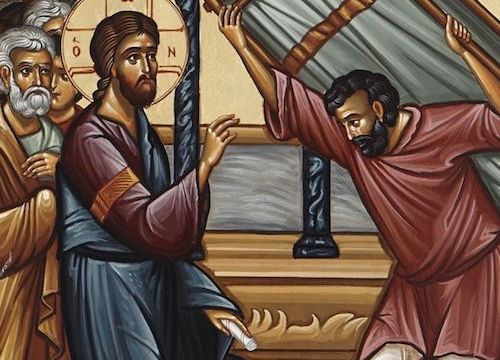
You too can move mountains – Thursday, 13th Week in ordinary time – Matthew 9:1-8
Read also https://www.pottypadre.com/body-and-soul-both-made-whole/
Chapter nine of the Gospel of Matthew has the last of the four miracle narratives. The first six were in chapter eight. Chapter nine also has Jesus calling Matthew to be an apostle and his is followed by a teaching on discipleship. It then winds down, giving way to the second of Matthew’s discourse in chapter ten; the mission discourse.
But chapter nine will also see the first sparks of confrontation that Jesus will have with the scribes (9:3), the Pharisees (9:11) and even with the disciples of his own cousin, John the Baptist (9:14). The passage of today has Jesus healing a paralytic. It is the first time that the Gospel of Matthew records the growing hostility between Jesus and the religious establishment of his time and in this case the ones who take umbrage at him are the scribes.
The Greek word ‘grammateus,’ translated scribe, means writer. The scribes were the ones who drew up legal documents. They also copied the Old Testament Scripture and devoted themselves to the study of the law, and the determination of its applications on daily life. They also studied the Scripture with respect to doctrinal and historical matters. Noted scribes had their own disciples and many of the scribes were members of the Jewish council.
We are no strangers to the healing power of Jesus. On this occasion, it is the power of petition that prompts Jesus to heal a paralysed man. Perhaps this miracle would have been without incident if Jesus simply took the man’s hand like he did with Peter’s mother-in-law. But St Matthew wants to make a point. Jesus is not just some wonder working miracle man; he is the Son of God whom even satan, who had possessed two men in Gadara, acknowledged as being so. For St Matthew, while Jesus has the ability to heal, he has even more, the authority to take away sins that were seen as the cause of illness.
His proclamation, “take heart son, your sins are forgiven” causes the scribes to be agitated. The scriptures do not tell us that they objected vociferously. Rather we are told that they had “evil thoughts in their hearts;” for they called him a blasphemer. This was the very charge that they brought against him at his trial (Matthew 26:65). The scribes correctly understood that Jesus claimed to do something that only God can do. But they were incorrect in assuming that Jesus was not God Himself.
Our Lord did not seek disputes. Yet when evil sets in our hearts we become the agents of satan and evil and then we are capable of attacking even our Lord. The evil in our mind pollutes our hearts, pushing us to train our guns against good men and women and turning the forces of evil against them. It is the little things, that we need to guard our heart from.
Finally, the Lord today was prompted to work a miracle looking at the faith of the friends of the paralytic. The paralytic perhaps had no faith at all; at least the Gospel does not seem to mention it explicitly. He was obedient, he took his mat and went home when he was told but as far as faith, we are told nothing. But it is the faith of the friends with which I want to end this reflection.
If there is anything that hits home in this text, it is the power of intercessory prayer. I have bemoaned the way the ‘prayers of the faithful’ are written and even more, prayed at Sunday mass. On one or two occasions in my parish, I have urged members in the congregation to come forward and make a spontaneous prayer. The silence that follows would make any school teacher ecstatic; but it is heart breaking for the minister. It is a moment when he realises how poor our faith is and how limited are our expressions.
We have failed to encourage spontaneous intercessory prayer. Such prayer when made in faith, moves mountains. It does not have to be wordy but simple words that come from the heart. ‘Heal a sister who has cancer Lord’, Help my neighbour get a job lord,’ ‘take care of our doctors and nurses who care for the sick.’ The list can be endless. The friends of the paralytic had their petition heard because they believed. Today, you can move mountains as you pray for those who are in need of your prayers for them.
The deliverer driven – Wednesday, 13th week in ordinary time – Matthew 8:28-34

The deliverer driven – Wednesday, 13th week in ordinary time – Matthew 8:28-34
Read also https://www.pottypadre.com/if-pigs-could-fly/
Chapters 8 and 9 of the Gospel of Matthew have ten miracle narratives punctuated by three teachings on discipleship. The Gospel of today focuses on the fifth miracle in this ten part series.
Jesus has had to deal with the incredulity of his apostles. He reprimands them, albeit gently for he found their faith lacking. The three miracles that he had worked in Capernaum had not convinced them that with Jesus in the boat they could smile in the storm. Now that the Sea of Galilee is calm once again, the apostles and the Lord arrive at the ‘other side,’ in the country of the Gadarenes. The country of the Gadarenes was more a region rather than some sovereign nation and it got its name from the town of Gadara on the south-east side of the lake. This was most certainly a Gentile region for we are told that its people reared pigs, an animal no Jew would ever touch, lest they be defiled.
Our Lord is encountered by two demoniacs coming out of the tombs, they are fierce and no one could pass that way. Right away, the demoniacs have no problem recognising who Jesus is; they call him the ‘Son of God’. How ironic it is that the twelve apostles, just a couple of verses earlier, ask “what sort of man is this?” in response to Our Lord calming the storm. If the demons recognise that Jesus as the Son of God, shouldn’t we?
At the time of Our Lord, there was a belief that demons were free to roam the earth until the Judgment Day came. They did this by taking possession of people. This possession was often associated with disease, because disease was the consequence of sin and a sign of being in Satan’s power.
Now they stand in the presence of the Lord, they know that this is a battle they won’t win. There’s no negotiation here as if they were equal partners at the negotiating table; Jesus is superior, and they know it and so they chose a way out; “send us into the heard of swine.”
The number of pigs isn’t mentioned in Matthew like it is in Mark 5:13 (“about two thousand”), but the herd is called large so that when the demons go out from the two demonised men into the herd and they all perish, we get the very clear sense of how big, how large, how serious these men’s bondage was, and how even this was no problem for Jesus.
But what happens next is even more surprising. The demons may have chosen their next place of residence but the swine would not have satan live with them for even a moment. They preferred death than having to live with satan. They rush down a steep bank into the sea and perish in the water.
The demons had clarity who the Lord was and seeing him they had a premonition that he was here to destroy them. It is they who say to him, “have you come here to torment us before the time.” What they did not expect is that the Lord was not here to give them a new comfortable dwelling or a change in residence. The Lord comes to conquer and destroy satan not to make him comfortable.
The narrative now takes an unexpected twist. For one, it does not tell us what happened to the two men in whom the demons had once taken residence. It takes for granted their new life of freedom from satan. However, we are told that the townspeople on being told what had happened begged Jesus to leave their neighbourhood. Were they scared? I think not.
The townsfolk should have asked Jesus to stay and stay forever, in order to be protected from any further attack. Why would you ask a mighty Messiah who has the power to deliver you from the clutches of satan to leave? The answer is obvious; we love our possessions more than the Lord. They would rather have their pork vindaloo on Christmas day but not the Christ who was born to save us.
Finally, to address the modern skeptics of the Bible, some who claim to be Christian and to whom demon-possession is rubbish. Such people claim that demon possession was just a primitive way that people described psychic or social disorders. But the Scriptures are not so accommodating to popular superstitions; if they were false or fanciful, they would correct them. Rather, they clearly affirm that there is a spirit world all around us that cannot be ignored. The war against satan is real.
My God my God, why have THEY forsaken us? – A reflection on Manipur

My God my God, why have THEY forsaken us? – A reflection on Manipur
I am on a two-year sabbatical; that is a privilege considering the shortage of priests in the Archdiocese of Mumbai. It would seem that every hand should be on the deck and here I am, away in Goa. While my compulsions of health and ideological issues have forced me to take time off, the “fire within me” does not seem to burn out. God, it seems, won’t let me go even though my Archbishop so kindly did. So, it is with fear and trepidation I write my thoughts while entrusting my life to being HIS disciple who spoke his mind.
Everything within me tells me to shut up and sit back and take my sabbatical easy but then there is this ‘Jeremiah moment’ that I seem to be experiencing all of this week. What is that you ask? I echo the sentiments of the prophet Jeremiah, not that I am even a far cry to who or what he was but that ‘Jeremiah moment’ resounds loudly. Jeremiah 20:9 says, “If I say, “I will not mention him (God), or speak any more in his name, then within me there is something like a burning fire shut up in my bones; I am weary with holding it in and I cannot.” So here goes…..
Manipur has burnt for more than 60 days. There is now enough evidence to point to the complicity of silence, if not more, of the powers that be; both federally and locally. Government officials have now told us that at least 500,000 pieces of ammunition, including grenades and mortars, and around 3,500 weapons were stolen in the riot-hit state and that too from the police armoury; that itself, as one commentator stated, is reason to file charges of sedition. These were most obviously put in the hands of those who have been given the mandate to terrorize the tribals of Manipur, many, if not most of whom, are Christians.
The Archbishop of Imphal has gone on record to state that more than 349 churches in the state were burnt within 36 hours of the violence erupting. That is not coincidence, that is a well-planned and coordinated attack. Fr Matthew Fernandes, director, NERSC, in an interview with Karan Thapar clearly indicated that churches in little know areas in the forests were targeted? How could city boys on motorbikes know where to go and what to target? This is the Gujarat model now being unleashed on Christians in Manipur and a model I suspect which is being perfected for other states too.
But is this too much to read all at once? Not at all. We have had enough of wrapping murder and violence in pretty bows of secularistic jargon and social niceties. It is time to call the failure of the Manipur government what it actually is, state sponsored ethnic cleansing. Which federal system allows an incompetent state government to continue in power sixty plus days into riots and looting and with what seems to be the clear intent to drive out the tribal Christians from their homes in forest? How does India’s first tribal President continue to keep her constitutional post in ceremonial splendour when her tribal people continue to suffer? Why has she not gone to them when they came to her at Rashtrapati Bhavan?
But why throw stones so far? Today, (July 2nd, 2023) the president of the CBCI, Archbishop Andrews Thazhath of Trichur, president of the Catholic Bishop’s Conference of India (CBCI), has directed Catholics throughout the country to observe this day as a day of prayer for peace in Manipur. Seriously Your Grace? More than sixty days after our brothers and sisters have been murdered, terrorized and displaced, all we can do is issue an appeal for prayer? Make no mistake, I am not undermining or diminishing the power of prayer, I am questioning the collective conscience of the Bishops of India and even more their collective silence. Why did the office bearers of the Catholic Bishop’s Conference of India (CBCI) not go hat in hand and camp themselves outside the Prime Minister’s office and demand no less for his silence to be broken?
This is the same prime minister who stood in White House just a week back and said, “democracy is in India’s DNA, it is in India’s spirit, in its blood, the democratic Indian government works on the basis of a democratic Indian Constitution, and if there are no human values, no humanity, no human rights, there is no democracy.” Really Modiji? Then why have you not uttered a word about the situation in Manipur or has that just become your style; to speak up too late? Is this but not tacit approval to those with vested agendas to continue the mayhem they have begun? The PM did not bat an eyelid when he spoke on foreign soil, in Australia to be precise, on the attacks on temples in that country; but not a word even when 349 churches were burnt and attacked in your own country and that too in one tiny state?
But to the many Christians who are reading this article, nodding their head in agreement, let me pick a stone for you too before you throw many at me in a series of questions that have come to be known as the ‘whataboutry’ form of evasion of the real issues at hand. Why are you silent while our brothers and sisters die in Manipur? Were you not educated by the Church whom you ought to defend? Why are you waiting for the hierarchy of the Church to speak up? Why have you relegated your role as voices of conscience to those who will not speak because they have ‘their compulsions?” How many Catholics have flooded face book and social media with their protests about the situation in Manipur as much as they have with the events of joy and blessedness in their lives (read your recent holiday or party)?
Ironically, I have reposted two or three articles on this matter on Facebook. Believe you me, not one like, not one share, not one comment as of this morning. I wonder if Facebook has received instructions to make sure that these post never get any likes. But what I fear more is the silence of this nation and in particular of the Christian community who have now begun to fear reprisal from government for speaking up for democracy. So much for a democratic nation!
I guess today I will lose friends on both sides of the aisle. The government for sure will not see this article as fair criticism. Today, to criticise the government makes you anti-national. It is more likely that you will go to jail for writing an article critical of the government but not for burning a Church. But I also suspect I will have lost friends in the Church because I dared to question their silence. The Gospel of today is emphatic, to be a disciple one has to put everything else in second place and embrace the cross of Christ. The fire burns in my bones!
Perhaps many may question why I speak just for my faith, my community; why not for all who suffer as we rightfully ought to each time violence breaks out. Let me make no apology for speaking for the underdog of the moment. The majority it seems, have the backing of government.
Christ bleeds on the cross; for the persecutors and the persecuted. Today, the people of Manipur, suffering with our Lord on the cross have this to say, “ My God, My God why have THEY forsaken us? “
Hello!
 Fr. Warner D'Souza is a Catholic priest of the Archdiocese of Bombay. He has served in the parishes of St Michael's (Mahim), St Paul's (Dadar East), Our Lady of Mount Carmel, (Bandra), a ten year stint as priest-in-charge at St Jude Church (Malad East) and at present is the Parish Priest at St Stephen's Church (Cumballa Hill). He is also the Director of the Archdiocesan Heritage Museum and is the co-ordinator of the Committee for the Promotion and Preservation of the Artistic and Historic Patrimony of the Church.
-
Anthony Murray Thank you Padre for your clear and defined analysis on true martyrdom and how it
-
PiusThoughts 202607-18-FrWarner – Sat 18-Jul-26 (When life deals you pain..) – St. Pius X Church […] Fr Warner D’SouzaSource: PottyPadre.com […]
-
Acts of the Apostles
ActsOfTheApostles
Advent
Advent2022
ArchdiocesanHeritageMuseum
Archdiocesan Heritage Museum
Archdiocese of Bombay
ArchdioceseOfBombay
ArtAttack
BombaySeminary
catholic
cheriillustrates
Easter
Easter2023
Faith
Friday
Goanfood
GospelofLuke
Gospel of Mark
indianfood
Jesus
John's gospel
Johnthebaptist
Lent
Lent2021
Lent2023
Lent2024
Lockdowncooking
Mary
Matthew's Gospel
Monday
padrecancook
padreinthekitchen
Padrewarner
Pharisees
pottypadre
Prayer
sacredart
SacredArtInHundredWords
Saturday
Scripture
StPiusXCollege
Thursday
Tuesday
Wednesday