Called to fight a holy war – Thursday, 30th week in ordinary time – Ephesians 6:10-20

We come to the end of the book of Ephesians. Even though tomorrows first reading, taken from the feast of Saints Jude and Simon the apostles is also a text from Ephesians, we will be bringing today an end to this series of teachings.

The author to the Ephesians draws the book to a close with a call to spiritual strength. The Christian is to arm himself or herself with the strength that God supplies and to maintain his or her vigil of prayer for one’s own battle against evil and also for the apostolic ministry. Ephesians 6:10-20 functions as a rousing conclusion to the entire letter in which Christians are being called to arms for the battle in which they are pitted against all spiritual forces of evil.

Even before chapter 6, Ephesians has been clear that evil spiritual forces, though defeated, are still active (1:21, 3:10). God’s victory cannot be snatched away, but the enemies have not surrendered yet. Paul has already told us in Ephesians 4:27 and in our text of today (6:11-12) that The devil has allied with all the evil powers of darkness. He continues to scheme against God, to work his destructive, divisive ends, and to attack the saints of God. Living as Godly people in an ungodly world poses a whole host of problems.
If you think that Paul has overstated the danger, you have closed your eyes to the overwhelming presence of evil in our midst. The violence and ruthlessness and greed that dominate so many lives to say nothing of the great divide that separates the very rich from the very poor. While there are many wonderful people in our world, there are also many who are evil at their core. So faith does not mean complacency or ignoring the daily reality of evil. One of Satan’s most successful ploys has been to persuade people that he doesn’t even exist.

So, Paul makes a clear call for a holy war; not with others but against evil. The Christian must be defended from evil and that defence comes from the spiritual armour that comes from God. To fight this battle, the entire church is enlisted and equipped to stand on God’s side in this continuing conflict.

If you think of it, Paul did not call the believer to enter into spiritual warfare. He simply announced it as a fact: we do not wrestle against flesh and blood, but (we do wrestle) against principalities and so forth. You are in a spiritual battle. If you are ignorant or ignore that fact, you probably aren’t winning the battle.

In Ephesians 6:11 we are told to “put on” the armour of God. The armour described in our text includes whatever prepares one to proclaim the “gospel of peace” (verse 15). The imagery used here is armour for violent battle; however, the strength advocated is not the might of armies, but the world-reconciling power of God embodied in the cross of Christ. The church stands “against the wiles of the devil” (Ephesians 6:11) by its love and reconciliation, by the peace and righteousness

Spread the love ♥
Continue Reading

Why do Catholics Receive Communion?

What is Holy Communion and why do Catholics receive It?
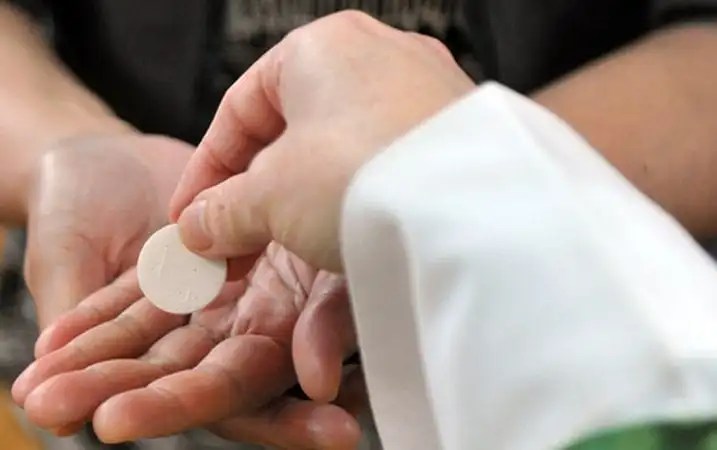
Well, the main reason that we receive Communion is because God told us to. At the Last Supper, our Lord told the Apostles to do this in memory of Him. But in some sense, that doesn’t answer the question. We can still ask: Why did Jesus ask us to do this in memory of Him? The answer is hidden in the word itself.

The word ‘communion’ comes from the Latin words ‘cum’ and ‘unio’ which mean ‘with’ and ‘one’. Taken together, the word ‘communio’ means ‘united with’. When we receive Holy Communion, we are being intimately united with God Himself, with all of the saints in Heaven and with every other Catholic on Earth, and this happens because of one of the central and most beautiful mysteries of our Catholic Faith: the Real Presence of Christ in the Bread and Wine of the Eucharist.

Yes, we are called to develop our relationship with God in personal prayer. Yes, we are supposed to reach out and serve the poor and needy. Yes, we are called to proclaim the Gospel and call people to repentance and faith in Christ. But in one sense, none of those are the ultimate point. We do all of those things in order to be more perfectly united with God and with our neighbour, and this is exactly what is accomplished when we receive Holy Communion. God Himself comes to literally dwell in us, and by being united to Him in the most intimate way imaginable, we are also united to one another in the same way. On top of this, receiving Communion actually strengthens us in doing those ‘other things’ I mentioned, like evangelization, works of mercy, and prayer and contemplation.

Each time you receive Communion is potentially the greatest moment of your life, but remember, this is not only physical food but also spiritual food. Prepare your spirit beforehand to receive Him properly. Spend time in personal prayer. Go for Adoration. Make a good confession. And after you receive Communion, make sure you sincerely continue in your efforts to become a saint.

Spread the love ♥
Continue Reading

Prawn/ Fish Caldine

500 grams prawns/fish
1/2 teaspoon salt – for marination
1/4 teaspoon turmeric powder – for marination

1/2 coconut
1 tablespoon coriander seeds
1 teaspoon cumin seeds
10 cloves
25 pepper corns
1 1/2 teaspoon turmeric powder
6 cloves garlic
One inch piece ginger
2 medium sized green chillies

1/2 a lime size of tamarind
One small onion finely chopped
One small tomato finely chopped
1/2 teaspoon vinegar
1/2 teaspoon sugar

Method
Marinate the fish/prawns with salt and turmeric. If you are using vegetables like cauliflower then soak the cauliflower in salted water to get out any unwanted pests

Grind the coriander, cumin, cloves and peppercorns into a powder and then add the coconut, turmeric, garlic, ginger and green chillies. Grind this into a paste

Empty the curry paste into a sieve ans add half a cup of water. With a clean hand or with a spatula remove all the juice. This is called the ‘ros’ and is the thick juice which needs to be set aside. Now put back into the mixture the dry curry paste, add one more cup of water and give it a spin. Take this off and extract the juice the second time. Do not mix the two juices.

In a vessel add about two tablespoons of oil and fry the onions till they are translucent. Then add the chopped tomatoes and render down completely. Add the second juice and drop the heat. From now on keep the curry on just below simmering heat. Add the sugar, vinegar and the juice of the tamarind that was soaked in hot water. Let this cook for about ten minutes on very low heat. Now add the fish/prawns/cauliflower and cook for five minutes. Check for salt. Finally add the first juice and give everything a stir. Cook for a minute more and again check for salt. At this stage if you would like the dish to be more than mildly hot add a slit green chilly. Turn the gas off and cover with a lid. The fish/prawns/cauliflower will continue to cook in its own heat .Serve on rice and always hot

Spread the love ♥
Continue Reading

Slavish obedience – Wednesday, 30th week in ordinary time – Ephesians 6:1-9

Today’s text is a continuation of yesterday’s teaching. Three analogies are presented in 5:21-6:9; husbands and wives, children and parents and masters and slaves. While the modern world may read these texts critically and even judgmentally, one has to keep in mind that these are but analogies to support the principal teaching of this text; obedience to Christ.

This does not mean that each of these analogies do not give us food for thought or content for debate. All of these analogies are applicable to the modern world; the relationship challenges between husbands and wives and parents and children are fraught by modern day challenges and while slavery may seem a thing of a bygone era, its ugly head has reared in the form of modern-day slavey; prostitution of young girls and women and child labour, to name a few. So, while we give a thought to these issues that serve today’s texts as analogies, the idea is not to lose the plot.

The author to the Ephesians is calling the Church to be obedient. This is the heart of the teaching. True obedience stems from love. When you love you may question; but your love pushes you to do that which the one you love desires from you. If that be so, then the Church will follow in obedience the commandments of Christ and embrace it with love; if not, every commandment becomes a burden and IF it is followed it is done so from a sense of duty or fear, certainly not love. Sunday mass being a case in point!

We have seen how marital relationships have been presented as a model of love and obedience. The author to the Ephesians now settles on parents and children (especially fathers). The commandment to obey one’s parents is grounded in the fourth commandment (Exodus 20:12 and Deut 5:16). This as we are told is the only commandment with a promise; if kept, we are blessed with a long life on earth. Seen in all the three analogies of obedience is a reciprocal action. Here fathers are called not to drive their children to resentment. To this is also linked the counsel to fathers; to bring up their children in the discipline and instruction of the Lord. Interestingly while the husband had the ‘apparent privilege’ of being the head of the wife he is also given a share of the responsibly that comes with ‘privileges. A father is called to be reasonable in his expectations from his children but is also it is his task to nurture a love for Christ in the hearts of his children.

Spread the love ♥
Continue Reading

Wives be subject; an analogy mistaken – Tuesday, 30th Week in ordinary time – Ephesians 5:21-33

Chapter 5:21- 6:9, the reading of today and tomorrow, focuses on the relationships among members of a household. In both form and content, it has many parallels in early Christian literature especially Colossians 3:18-4:6. Today’s text focuses on husbands and wives; tomorrow we will look at parents (fathers in a special way) and children and finally on slaves and masters. In each of these three relationships there is a call to obedience. In that sense, verse 21, which calls for obedience to one another out of reverence for Christ, can be seen as an introduction to all three groups of people.

These texts may raise eyebrows. Obedience in our day and time sounds servile and there is a tendency to disregarded these texts and in the case of master and slaves, even their context, as belonging to another era. But it would be foolish to throw the baby out with the bathwater. We need to examine the heart and mind of the author of the Ephesians. Having said that, while obedience is called for, it is not servitude that is demanded. If you study the texts, you will see that for every injunction there is a reciprocal responsibility that is also called for. If wives are called to be subject to their husbands, then husbands are called to love their wives. If children are called to obey their parents, then parents are called not provoke their children. If slaves are to obey their earthly masters, then masters are called to stop threatening them.

So, let’s state the intended intention of this text rather than get lost in the subtext. The author to the Ephesians is concerned primarily with the desire to define the nature of the Church. This is the point that we need to focus on. He says this plainly in verse 32 “this is a great mystery and I am applying it to Christ and the Church. “The Church is subject to Christ; he is the head”. This is the point being mad. In order to express this truth, the author to the Ephesians finds a parallel in the institution of marriage, family and society, borrowing largely from the social behavioral patterns at that time. So, let’s says this again, primarily this is not a teaching on marriage or parenting skills or social emancipation.

Spread the love ♥
Continue Reading