
Feast of St Lawrence – John 12:24-26
Feast of St Lawrence – John 12:24-26
St. Lawrence was born in 225 AD and lived during the early years of the Church and experienced the harsh persecution of Christians under Roman Emperor Valerian. To this day, little is known about the details of St. Lawrence’s life. However, we do know the Church holds him in high esteem and that his holy example was formative in the early years of the Church. Stories of St. Lawrence include his direct opposition to Emperor Valerian and his love for the true treasures of Christ’s Church and His people; the poor.
Saint Lawrence was one of seven deacons who were in charge of giving help to the poor and the needy. The word “deacon” comes from the Greek word, “diakonos,” which means “servant” or “helper.” Sacred Scripture recounts how deacons served the needs of widows in the early Church (see Acts 6:1-6). Thus, as a deacon, St. Lawrence’s life was dedicated to serving the poor and needy.
When a persecution broke out, Pope St. Sixtus was condemned to death. As he was led to execution, Lawrence followed him weeping, “Father, where are you going without your deacon?” he said. “I am not leaving you, my son,” answered the Pope. “in three days you will follow me.”
Lawrence was the custodian of the material goods of the Church, and was responsible for the distribution of alms to the poor. Lawrence knew he would be arrested just like the Pope and knowing the hatred of the Emperor was extending to all Christians who owned property, began to give it all away. He gathered the poor, the widows and the orphans and gave them all the money he had on hand, selling even the sacred vessels of the altar believing the clear admonition of the Saviour that they were blessed and especially loved by Him.
Emperor Valerian heard the news. He imagined that the Christians must be having a considerable treasure. Valerian wanted the treasure to satisfy his unbridled lust for worldly power. He offered Lawrence a way out of sure death. If he would show him where the Church’s great gold and silver were located, he would issue an order of clemency, sparing his life so that he could continue his work.
Lawrence asked for three days to collect the ‘wealth’ of the Church. Valerian thought the Church had a great fortune hidden away. So he ordered Lawrence to bring the Church’s treasure to him. For three days, Lawrence went throughout the city and invited all the beloved poor, handicapped, and misfortunate to come together.
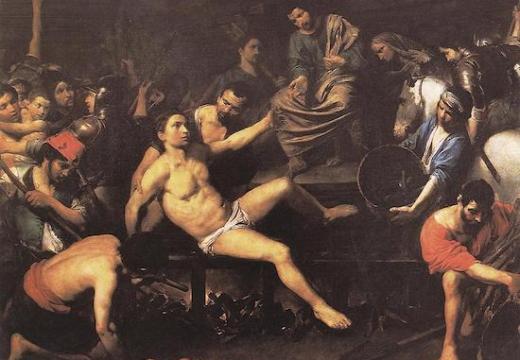
When Valerian arrived, Lawrence presented him with the true gold and silver of the Church, the poor! The emperor was filled with rage! Beheading was not enough for this Christian Deacon. He condemned Lawrence to a slow, cruel death. He ordered that Lawrence to be burned alive, in public, on a griddle. Witnesses recorded the public martyrdom.
The Saint was tied on top of an iron grill over a slow fire that roasted his flesh little by little, but Lawrence was burning with so much love of God that he almost did not feel the flames. In fact, God gave him so much strength and joy that he even joked. “Turn me over,” he said “I’m done on this side!” And just before he died, he said, “It’s cooked enough now.” Even at the brink of death, his peaceful joy shone through. In Scripture, “joy” is listed as a fruit of the Spirit (see Galatians 5:22-23), and St. Lawrence certainly possessed this joy! The comedians of today can take a page out of the creator of the ‘roast’. Before his death he prayed that the city of Rome might be converted to Jesus and that the Catholic Faith might spread all over the world. After that, he went to receive the martyr’s reward.
Lawrence died on August 10, 258. His feast spread throughout Italy and northern Africa. Emperor Constantine built a beautiful basilica in Lawrence’s honour. St. Lawrence is among the saints mentioned in the First Eucharistic Prayer at Mass. He is the patron saint of school children, poor people, cooks and comedians to name but a few.
Prayer to St. Lawrence, Deacon and Martyr
O Generous patron of the Church’s poor, St. Lawrence, pray to the One God, Father, Son and Holy Spirit that all the poor of the Church in need in every corner of the world may feel the effect of the love of their brothers and sisters who seek to help them.
Deliver the Church from the greed and envy of the powerful and protect her rights and property so that she may serve the needy in freedom, giving them good things for soul and body.
May we come some day with all those whom we helped on earth to the bright mansions of heaven where we will enjoy the riches of God’s house and the company of the Saviour who lives and reigns forever and ever.
Amen.
A mouth full of words – Tuesday, 19th Week in ordinary time – Ezekiel 2:8-3:4

A mouth full of words – Tuesday, 19th Week in ordinary time – Ezekiel 2:8-3:4
We are nourished from two tables at the Eucharist. The table of the word and the table of the bread. Often, we think that the table of the bread (Eucharist) is more important than the nourishment we get from the table of the word (the readings of sacred scripture) and so we permit ourselves to enter mass late; enquiring about the ‘validity’ of mass when we are late. Hold on to this thought as we study today’s text.
Ezekiel was called by God while in exile. Like the prophet Isaiah he was a priest but scholars have opined that before he exercised his priestly ministry in Jerusalem, he was taken off into exile along with King Jehoiachin and thousand others in the 598BC. It will be several years later under King Zedekiah that Jerusalem will finally be destroyed. Ezekiel is now called by God in exile, in Babylon, to be his prophet.
God speaks to Ezekiel and calls him a ‘mortal’. In several translations this reads as ‘son of man’. This is a phrase peculiar in the Old Testament to Ezekiel with the exception of two instances in the prophet Daniel. It is used 93 times in Ezekiel and its purpose is to emphasise the great gap between a transcendent God and the human being. But in Daniel it takes on a messianic meaning, taken up later by Jesus, who refers to himself several times as the (not a) “Son of Man”.
In chapter one, Ezekiel see the vision of a chariot with four living creatures with human like form. He fell on his face when he heard a voice speak to him. Today’s text describes a strange apocalyptic vision but its meaning is clear. The voice that he hears commands him to stand and commissions him to do as he is told. Ezekiel is given a brief background of the people he is to speak of; his own people. The biography of the people he is to prophecy to is brief because they are predictable; they and their decedents are no different (2:4). God calls them ‘a nation of rebels and sinners’ (2:3). ‘They are stubborn’ (2:4).
At this time the children of Israel still had something of a kingdom in Judah and a temple in Jerusalem. Yet many of them were also scattered across the Middle East, by the forced exiles under the Assyrians and the Babylonians. Ezekiel’s word was for all of them.
The vision of the chariot – Monday, 19th week in ordinary time – Ezekiel 1:2-5, 24-28c

The vision of the chariot – Monday, 19th week in ordinary time – Ezekiel 1:2-5, 24-28c
We begin with the last of the three great prophets. The prophetic ministry of Ezekiel is set in a very turbulent background of the history of the people of Judah. These were the last few years of Judah’s independence and the last few years of the existence of the temple built by Solomon.
The Assyrians who had taken into exile the people of the northern kingdom in 723 BC found themselves by the year 628 BC, a weakened and tottering nation after the death of its last strong ruler, Ashurbanipal. At this time, King Josiah began the spiritual reforms in Judah but he lost his life in a battle with the Egyptians and his son was taken captive by the Egyptians. They Egyptians replaced his heir with another son and Jehoiakim becomes king in 609BC. Jehoiakim is unfaithful to Yahweh and has several run-ins with the prophet Jeremiah who accuses him of rejecting the covenant.
In 605, political events brought the Babylonians to power over the region and Judah. Judah becomes a vassal state to this new emerging superpower. At about this time, Babylon almost lost a battle to Egypt in the south in 601 BC. King Jehoiakim thought that a weakened Babylon should be challenged now or it will be too late to assert Judah’s independence. He was horribly wrong!
In 598 the Babylonian army sacked Jerusalem and exiled thousands of its leading citizens to Babylon. While Jehoiakim died, the new king, Jehoiachin was taken prisoner to Babylon along with men like Daniel and the newly ‘ordained’ priest, Ezekiel; the prophet of this book.
King Nebuchadnezzar of Babylon, appointed the uncle of King Jehoiachin as king-regent. King Zedekiah would be the last of the kings of Judah before they were taken into captivity in 586 BC. However, several years into his reign, Zedekiah revolted against Babylon much against the instructions of Jeremiah.
The Babylonians would have no more of the shenanigans of Judah. They laid siege to Jerusalem from 589-586,]’breaching its walls, burning the city, destroying the temple and taking into exile her people before killing the young princes before Zedekiah’s own eyes and then tearing those same eyes out.
The transfiguration of the Lord – Luke 9:28b-36

The transfiguration of the Lord – Luke 9:28b-36
In the Gospel of Luke, the narrative of the transfiguration is preceded by the confession of Peter, “You are the Messiah of God.” And this is followed by a passion prediction of Christ, that he must die and also several teachings on discipleship. The teachings on discipleship are important in the context of the transfiguration in the Gospel of Luke.
Eight days after the confession of Peter and the teachings on discipleship, Jesus takes with him Peter, James and John up a high mountain to pray. The transfiguration takes places in the context of prayer. Neither Matthew (17:1-8) nor Mark (9:2-8) mention that Jesus went up the mount of transfiguration to pray nor do they mention about the transfiguration while he prayed.
What started as a mountain top prayer meeting quickly changed into the shining forth of the glory of Jesus. As He prayed, Jesus was transformed right before the eyes of the disciples; his face changed and his clothes became dazzling white. Unlike Moses (Exodus 34:29-35), Jesus is not experiencing God’s glory but is the very source of glory. In fact, Luke does not even use the word ‘transfigured’ but simply says his face changed. Matthew says that Jesus’ face shone like the sun (Matthew 17:2), and both Matthew and Mark used the word transfigured to describe what happened to Jesus. For this brief time, Jesus took on an appearance more appropriate for the King of Glory than for a humble man
It is here that Moses and Elijah appear talking to him. Moses represented the law and Elijah represented the prophets. The sum of Old Testament revelation came to meet with Jesus at the Mount of Transfiguration. Interestingly they are speaking of his ‘departure’ which he was about to accomplish in Jerusalem. Of all the things they might have discussed, they chose this topic. We can almost picture Moses and Elijah asking, “are You really going to do it?” Some translations do not use the word ‘departure’ but speak of his ‘exodus’. The old exodus was from Egypt to Jerusalem, the new exodus for Luke will be from Jerusalem to heaven.
In all of this, a rather sleepy Peter, noticed that this was all winding down. He suggested that three tents be made. Perhaps Peter thought, ‘this is how it should be! Forget this idea of suffering, being rejected, and crucified; let’s build some tabernacles so we can live this way with the glorified Jesus all the time. Peter’s suggestion meant that not only would Jesus avoid the future cross, but so also would Peter.
We are told that a cloud overshadows them and as they stepped into the cloud, they are terrified. Peter may not have known what he said, but he knew what he saw; the cloud of glory was real and he was wide-awake when he and the apostles saw it. We are not sure whether the voice that spoke to them in the cloud calmed them but we know that the voice of God affirms what Peter had earlier declared about Jesus; that he is the Messiah. But now the voice also demands a listening ear. “This is God’s son, the chosen, listen to him”. Peter. James and John are told to “listen to Jesus.” The voice of God calls the disciples to listen. They were in danger of being distracted by what they witnessed and might have missed the meaning that they had to listen closely for.
Hello!
 Fr. Warner D'Souza is a Catholic priest of the Archdiocese of Bombay. He has served in the parishes of St Michael's (Mahim), St Paul's (Dadar East), Our Lady of Mount Carmel, (Bandra), a ten year stint as priest-in-charge at St Jude Church (Malad East) and at present is the Parish Priest at St Stephen's Church (Cumballa Hill). He is also the Director of the Archdiocesan Heritage Museum and is the co-ordinator of the Committee for the Promotion and Preservation of the Artistic and Historic Patrimony of the Church.


ActsOfTheApostles
Acts of the Apostles
Advent
Advent2022
AdventReflections
ArchdiocesanHeritageMuseum
Archdiocesan Heritage Museum
Archdiocese of Bombay
ArchdioceseOfBombay
ArtAttack
BombaySeminary
catholic
cheriillustrates
Easter
Easter2023
Faith
Friday
Goanfood
GospelofLuke
Gospel of Mark
indianfood
Jesus
John's gospel
Johnthebaptist
Lent
Lent2021
Lent2023
Lent2024
Lockdowncooking
Matthew's Gospel
Monday
padrecancook
padreinthekitchen
Padrewarner
Pharisees
pottypadre
Prayer
sacredart
SacredArtInHundredWords
Saturday
Scripture
StPiusXCollege
Thursday
Tuesday
Wednesday